Showing posts with label Temples. Show all posts

Sunday, 6 January 2013

Sri Lanka Part 3

Supun, her family and I devoted a whole day to historical Sri Lanka.

Anuradhapura

We started off early around 6am and rode up together in the family van.  We stopped for a breakfast picnic at a scenic lake.  There were many other Sri Lanka families enjoying the sights and warm sunny weather.  We had some tasty food.  I impressed Supun's family with my ability to enjoy spicy foods.  We then continued on to Anuradhapura, Sri Lanka's first capital.  It's history was quite old as it was built around 500 B.C.  There we saw another one of Sri Lanka's most sacred spots.  It is a temple with a descendant of the original Bodhi Tree under which the Buddha gained enlightenment.  A branch from the original tree was planted in 288 BC making it the oldest verified specimen of any angiosperm (type of tree).  At the temple we made an offering, lit incense, received a Buddhist string bracelet and made a wish.  If my wish comes true then I will have to return at some point to the Temple to give thanks.

We also saw the Ruwanmalisaya, which is a large white stupa dedicated to the Buddha.  It was a very impressive site an another important Buddhist site.


Sri Maha Bodi - descendant of the original bodi tree
Mihinthale

Our next stop was Mihinthale.  It's a great overlooking spot near Anuradhapura.  Supun said it was her favorite so despite being pressed for time we included it in our lengthy itinerary.  At the top of this scenic overlook were temples, stupas, and statues.  we raced up to the top and were rewarded with expansive views and a peaceful environment.  This was impressive but not as impressive as what was to come.

Minthale - a very pleaceful place
Authentic Sri Lankan lunch

For lunch we stopped at a local Sri Lankan restaurant.  We all sat down to eat and then Supun realized that they hadn't brought me silverware.  In most countries this would be noteworthy but in Sri Lanka everyone eats with their hands.  Well when in Rome... I didn't want to be an outsider so I joined in using my hands.  There's definitely a technique to it (using just the tips of the fingers, starting from the edge of the rice and using the thumb to push it into my mouth).  It was much easier to pickup than chopsticks.  I once again ate the spicy food and they joked that if I was a little tanner, I could almost past for a Sri Lankan (until I spoke of course).

Sigiriya

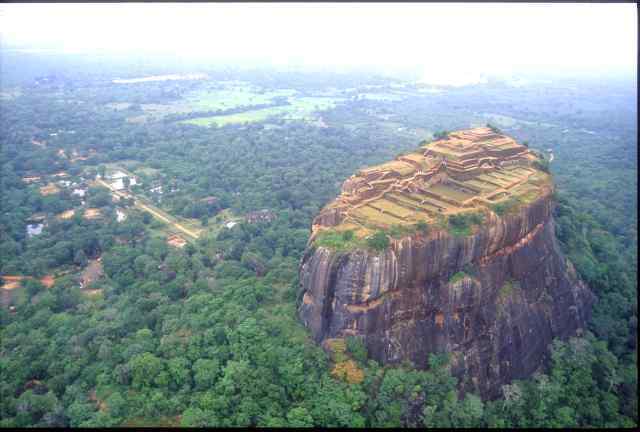
Our journey continued to Sigiriya, the Lion Rock.  I could best describe it as a mix of Machu Pichu and the Sphinx.  Sigiriya is a palace complex built on top of a mountain-boulder by a rogue Sri Lankan king.  The King had killed his father to usurp the throne and he feared revenge from the brother who was the rightful heir.  So he moved from the capital and build this vast complex to defend himself.  He created vast irrigation terraces for food, swimming pools and catchment pools.  He commisoined gorgeous cave paintings (still preserved) to distract any attackers.  He also built amazing walls, fortresses and statues.  The top had amazing views of the jungle, mountains and farmland of north central Sri Lanka.  It was an absolutely brilliant place that stimulate my senses and imagination.  A must see.

In front of the beautiful Sigiriya 
View from above - notice the beautiful landscape and the intricate irrigation
Supun at the entrance - it used to be a lions head but now is only the paws
View from the top of Sigiriya

Wall paintings meant to distract invaders and entertain tourists
Distracting paintings!
Panoramic of the beautiful scenery around Sigrirya
Enjoying the view
The Return

We returned back to Kandy through 1-lane roads and treacherous traffic.  It was an amazing day.  That night I stayed in St. Bridget's Guesthouse.  It was a homely guesthouse with great hospitality and authentic food.  I enjoyed the traditional dinner with some Sri Lankan beer.  After a solid night's rest I awoke for some meditation and early sustenance.  The house keepers made homemade pineapple and passion fruit jam that was deliciously sweet.  I then met up with Supun to explore the Botanical gardens.  We saw the bridge and sites and then toured the city in search of any Sri Lankan foods I hadn't tried.  We got an orange coconut thing, a fried pasty, and ice cream.  The inevitable goodbye was said and I was sad to leave.  I then took the train back to Colombo to catch my flight.  This ended the last of my Asian trips.

Lion Lager is a local beer - a light and crisp taste
Delicious homemade Sri Lankan meal at Bridget's Hostel
Thambili King Coconut like drink - delicious
Food Recap

So with Supun's help I came up with a list of foods I tried while in Sri Lanka.  It varies from the really exotic to the had-it-before-but-tasted-better in a tropical place:

  • Fish Curry
  • Sri Lankan Cream Soda
  • Prawn Buiriyani 
  • Thambili (king coconut)
  • Hoppers - fluffy light pancake-like
  • Koththu - noodle/egg dish
  • String hoppers- iddi aapa
  • Cutlets
  • Malu paan - bun with marinated fish in it 
  • Rolls
  • Tropical fruits: mango, papaya, pineapple, white guvava
  • Wade
  • Extra sweet sri lankan tea
  • Traditional Sweets- dodol, aluwa, milk toffee, kawum
  • Poll sambal ( chiili coconut with salt and lemon)
  • Daal
  • rice and different curries
  • papaya drink
  • woodapple drink 
  • Lunu Miris (chilli dip for aapa)

Friday, 4 January 2013

Sri Lanka Part 2


After my crazy journey from the airport to the hostel to the train in Colombo, I was relieved to be arrive in Kandy.  Waiting at the station was my friend Supun with her driver.  With Supun’s guidance and help I would see much more of central Sri Lanka in 48 hours than I ever thought possible.

Australian friends in Sri Lanka

Supun is a friend I met will studying abroad in Fremantle, Australia.  We were put into the same volunteer group that traveled to the Australian outback.  We had a ton of fun learning gardening, farming, construction, and hunting knowledges from the locals.  We even went rabbit and kangaroo hunting late at night with our hosts.  Supun’s spunky optimistic Buddhist ideals balanced my snarky Western sarcasm.  We’ve stayed in touch with email for the past five years but this was the first time we’d been able to catchup.  During all those years she implored me to visit Sri Lanka so when I got the chance while in Asia, I took it.   And it worked out quite well as Supun would also be in Sri Lanka during that time for a Med School elective. 
From the train station we took a three-wheeler to her relative’s place where she was staying.  They showed me warm hospitality with a tea with milk and sugar.  The saying goes that the more someone likes a guest the sweeter they make their tea.  This tea was very sweet!   Supun and I got to hang out with the little grandson there who was adorable.  

Elephant Orphanage

After packing supplies for our day we took the three wheeler to the Pinnawala ElephantOrphanage.  The journey was a bit long and bumpy on the three-wheeler but it was exciting and scenic as well.  The Elephant  Orphanage was fantastic.  They had 30-40 elephants of all ages and shapes.  When we saw them they were bathing in the river.  Supun and I were able to pet and feed them bananas.  Feeding them was tricky as we’d offer them one banana and their trunk would go straight towards the bag with the rest of the bananas.  The mischievous elephants were clever and nimble.  We spent an hour or two watching them frolic and socialize in the water.  The young baby elephants were especially playful and energetic.  After their bath, the elephants marched to their home.  We watched from a few feet away as these massive animals stormed back with alarming speed and power. 

Elephants bathing at the river near the Orphanage
Elephants powering through the streets
Elephant harassment - not sure who is giving or receiving
After the orphanage, we purchased a few souvenirs from the area and were then on our way to grab some Sri Lankan lunch.  Supun consistently insisted that I try every Sri Lankan food possible.  This made for a tasty and filling experience.  At the pre-lunch spot we grabbed fish rolls, lou mapan, and deserts.  The last time I had met with Supun, my taste in food was rather bland.  This time I was able to eat all the spicy stuff without complaints.  In fact, I impressed and shocked many of the Sri Lankans with my ability to eat the local food. 

Hospitals in Sri Lanka may get you sicker

After the pre-lunch we visited the public hospital she was working at.  In Sri Lanka, public hospitals offer all their services and medicines for free to the population.  As such it’s oversubscribed and underfunded.  The hospital floor reminded me of a war hospital with many beds crammed into an open room and patients writhing in pain.  The sanitary conditions were not up to western standards, for example, stray dogs just wander through.  Supun’s advice was “don’t get sick and if you do, go to the hospital once you get back”.  At the hospital we caught up with Supun's colleague and friend Chalani.  

Kandy City

We traveled to Kandy the major city in central Sri Lanka.  There we visited the Sri Dalada Maligawa, The Temple of the Sacred Tooth Relic, one of Sri Lanka's most holy spots.  It contains a tooth from the Buddha which had immense spiritual importance as well as political relevance.  The rulers of Sri Lanka used possession of the tooth as a sign of government legitimacy.  In the temple was a museum that had the history of the tooth.  The legend says the tooth came over in the hair of a princess and the tooth was then shuttled from capital to capital over millenia as Sri Lanka resisted invasion.  

The temple itself was impressive in it's aura, beauty and decoration.  We offered flowers, said a prayer, lit a candle and lit incense, which came in handy later in the day.  Every year the people around Kandy celebrate Esala Perahera, the festival of the tooth.  It has ornately decorated dancers, elephants, music and much more.  The ceremony has come to symbolize Sri Lanka.  It was highly recommended that I come back for Perahera.

At the temple with our flower offerings
Perahara pictures of ceremony at the Sri Dalada Maligawa.
After the temple, we grabbed some food and prepared for our journey to the north.  We grabbed some egg hoppers and kutto for a nice meal.  Disaster struck though.  As we were leaving Supun realized her iphone was misplaced.  After a bit of panic by everyone we deduced that it must have been left back in the parking lot we were at 15 minutes prior.  So we drove back knowing that the odds of finding the phone were low.  But upon arriving back we saw the iphone in it's glorious pink case.  It landed face down and was right by where our car had been.  A minor miracle to say the least given how busy the parking lot was and how long the phone was left there.  We gave credit to our offering at the Temple for bringing us good fortune. 

The next day Supun and some of her relatives picked me up for a journey north to some of the most spiritual and beautiful sights in Sri Lanka.

Saturday, 18 August 2012

Cambodia Weekend Part 2: Temples of Wonder not Doom

Angkor Wat was the main reason I had Cambodia on my must visit list.  The pictures and descriptions of the temple were amazing and it's been considered an alternate wonder of the world.  I did a little prior research on the temple and the Khmer empire that built it, but seeing it, touring it and being in Siem Reap was an incredible learning experience.

Angkor Wat

This massive complex is the largest Hindu temple in the world.  It was built in the 12th century at the behest of King Suryavarman II.  Angkor Wat resembles the Hindu Mount Meru (home of the Devas).  The temple is surrounded by a giant moat that is a 190m wide.  The dimensions correspond to Hindu beliefs and the structure is renowned for its harmony of design.  Given that all non-religious Khmer structures were built with perishable items makes this even more impressive.

Here are some pictures we took at sunrise:

There are five major towers with the largest in the center
The jungle scenery around the temple is fantastic as well
The major distinguishing feature is the five towers shaped like lotus buds.  These five represent the five mountains at Mount Meru.  This shape of tower appears frequently throughout Khmer architecture.

Megan staring in awe at one of the towers
The walls of the temple have amazingly intricate bas-relief sculputres that tell Hindu Epics such as the Ramayana.  The scope and detail were astonishing.  Here's some pictures that will woefully not do it justice:

Bas-relief of an epic battle scene
We hired a tour guide which I highly recommend.  He provided alot of the background, explained the bas-reliefs in detail and answered all of our questions ("Why is there a huge staircase there?" "It's a swimming pool" "Oh, cool").  Angkor Wat is very impressive.  A few more of my favorite pics.

Megan and I at the temple entrance

Angkor Wat moat

Vishnu  the Hindu's Preserver of the Universe - our awesome guide is to the right

The "Cool" swimming pool.

Interestingly, even though Cambodia is~95% Therevada Buddhist now, people still pray at this Hindu temple.  They've in a way converted it over and as a consequence it's stayed in very good shape.


The Khmer Empire built a lot of impressive temples besides Angkor Wat; something I learned while in Cambodia.

Angkor Thom and Bayon

Angkor Thom was the capital that was built a bit after Angkor Wat.  The Bayon temple is at the center of the capital exactly 1.5 KM from all four entrances.  The entrance to the capital has a moat and a bridge theme that is seen throughout.  It has the Gods and Demons holding Dragons as part of the churning of the Ocean of Milk story.

Restored Demon heads at the gates to Angkor Thom
Right next to the "Demon with Bad Teeth"
The Bayon temple was one of my favorites.  Like Angkor Wat it has beautiful bas-reliefs.  These sculptures tell not only Hindu epics but also provide details about everyday life in the Khmer Empire.  Something archaeologists surely appreciate.  It is amazing that the everyday life depicted in this 12th century temple was not all that different from the everyday life of Cambodians in the 19th century.

Bayon Temple

The erie faces of Bayon Temple - rumored to be King Jayavarman VII
The sculpture faces of the Bayon Temple are really cool.  Many of the columns have faces on four sides facing the cardinal directions.  This reminded me a bit of Legends of the Hidden Temple for you children of the 80s-90s.  There are an estimated 200 faces total but that number could be higher for the original building.  The construction materials and upkeep of the Bayon temple is inferior to Angkor Wat and consequently there has been decay.

Ta Prohm

King Jayavarman also built Ta Prohm which he dedicated to his mother.  It was originally purposed as a monastery for Buddhist monks.  Ta Prohm housed several thousand people, and it required over 100,000 people from over 5,300 villages to provide rice and supplies for it. 

The way the trees have grown on the temples is very moving and beautiful.  Ta Prohm is so scenic and mystical it has shown up in movies such as Tomb Raider and Troy (granted not the best movies but still).


Other cool photos

Hindu temple built in a pyramid style


Temple ruins of Prea Khan
The temples are set in a jungle-like ecosystem

Conclusions

  • The detail and scale of these temple monuments demonstrates how important religion was to the culture and political environment of the Khmer Empire.  In contrast, the most impressive buildings made by modern Western Civilization are testaments to commerce (Sears Tower) and sports (Yankee Stadium).
  • It was great to see the temples in person to get an appreciation for the amount of work and skill needed to build these temples.  Simply massive.  
  • Another interesting lesson was the non-linearity in human progress.  The Khmer Empire built these great temples in the 12th century and then mediocrity ensued in the region for hundreds of years.  The mediocrity was due to a combination of environmental factors (overpopulation stressing irrigation resources and overusgae of suitable building materials) and political factors (Cambodia was at the fault line between two emerging powers that differed significantly in culture, Thailand and Vietnam).  But I think it is human tendency to want to see growth in a linear manner versus booms and busts, whereas the booms and busts tend to occur more naturally.
  • Angkor is a continued source of price to Cambodians.  It is on their national flag and has been a positive to point to despite tough times (Declining empire, Khmer Rouge, economic difficulties, etc.).
Clearly Angkor is still a source of Cambodian pride
My next post will be about the other adventures we had in Cambodia; including Cambodian cooking classes, a Cambodian night club, a somber visit to the Genocide museum, an authentic Cambodian bus ride, and a biking tour through the islands of the Mekong.